Using AI Win Probabilities to Plan Your Fantasy Premier League Gameweek 1
Published 1 August 2026 · FootyPulse AI Analysis
7 min read · Updated 14 August 2026
Fantasy Premier League searches have exploded over the past week — up as much as 350% for some search terms — as millions of managers start building squads ahead of the 21 August kickoff. Most early-season captaincy picks come down to gut feeling, last year's form, or whoever's trending on social media. FootyPulse takes a different approach: every Gameweek 1 fixture already has a real, data-driven win probability behind it, generated the same way for every match in the league — and that's exactly the kind of signal FPL decisions should be built on, not an afterthought.
Here's how to actually use it.
Why fixture-based win probability is a real FPL signal
Fantasy football scoring rewards two things above almost everything else: goals (and assists) for attackers, and clean sheets for defenders and goalkeepers. Both of those outcomes are directly tied to how comfortably a team is expected to win — a team heavily favoured to win is, by definition, also more likely to score multiple goals and to keep the opposition off the scoresheet.
That's not a coincidence, and it's not unique to FootyPulse's approach — it's the same underlying logic behind every serious football analytics model. What FootyPulse adds is transparency: every win probability on the site is generated from the same real inputs (recent form, head-to-head record, home advantage, goals scored and conceded per game) for every fixture in the league, and — unlike most prediction sources — we publish our full accuracy record in public, including the misses. If you're going to build FPL decisions around a model's output, it's worth knowing whether that model is actually any good. Ours is checkable.
The safest Gameweek 1 captaincy picks
Two fixtures stand out from the rest of the Gameweek 1 round with a genuinely lopsided win probability — and lopsided fixtures are exactly where FPL captains earn their double points.
Manchester City vs Bournemouth (68% City win) is built on a dominant home record: a 74% win rate and 2.40 goals scored per game at the Etihad, against just 0.70 conceded. That combination — high scoring rate, low conceding rate — is precisely the profile that tends to produce both attacking returns and clean sheets in the same match, which is what makes a fixture genuinely strong for both a captaincy pick and a defensive one.
Arsenal vs Coventry City (78% Arsenal win) is the single most one-sided fixture in the entire Gameweek 1 round — in fact, the most lopsided fixture FootyPulse's model has assigned all season. Arsenal's 79% home win rate and 2.20 goals per game at the Emirates, against a side two divisions below in quality, makes this the standout captaincy fixture of the opening weekend for anyone holding an Arsenal asset.
Both of these are what most FPL managers would call "template" picks — obvious, safe, and likely to be heavily owned across the game. There's nothing wrong with that: a genuinely lopsided fixture is lopsided for a reason, and fading it purely to be different is a gamble in the wrong direction more often than not.
The genuine toss-ups — and why differentials live here
Six of the ten Gameweek 1 fixtures are much closer calls, with no side clearing a 48% win probability:
- Everton vs Crystal Palace — Everton 38%, draw 32%, Palace 30%. Genuinely the tightest fixture of the round.
- Ipswich Town vs Sunderland — Ipswich 48%, draw 28%, Sunderland 24%. A promoted side favoured, but not comfortably.
- Nottingham Forest vs Leeds United — Forest 48%, draw 28%, Leeds 24%.
- Brentford vs Tottenham Hotspur — Brentford 38% at home, draw 27%, Tottenham 35% away. As close as fixtures get.
- Brighton & Hove Albion vs Aston Villa — Brighton 34%, draw 28%, Villa 38% away.
- Fulham vs Chelsea — Fulham 48% at home, draw 28%, Chelsea 24%.
This is exactly where FPL "differential" thinking — picking assets the majority of managers won't have — makes more sense than in the Arsenal or City fixtures above. When a match is genuinely close to a coin flip, the popular, heavily-owned pick has no real statistical edge over a differential one. The upside of being right on a differential is highest precisely in matches where the model itself isn't confident either way.
See live, updated win probabilities for every Gameweek 1 fixture →
Beyond Gameweek 1: which squads deserve long-term FPL investment?
Individual gameweeks matter, but Fantasy Premier League success is really decided by which squads you back for the season as a whole — who you give your captain's armband to in November matters as much as who gets it in Gameweek 1.
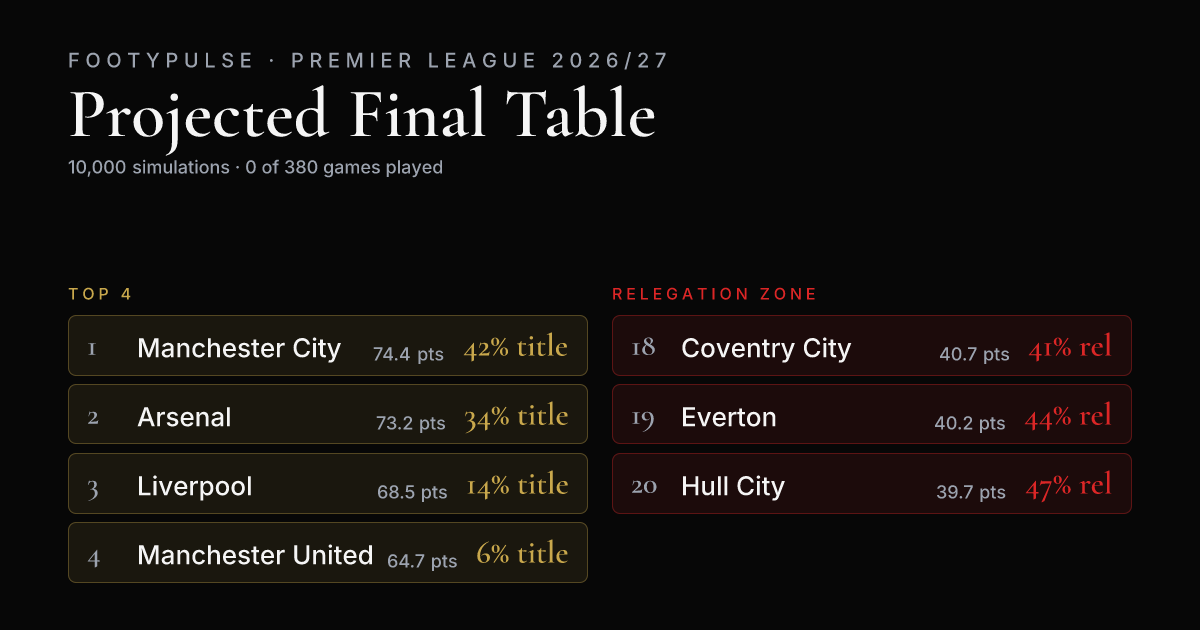
To help answer that, FootyPulse simulated the entire 2026/27 season 10,000 times, using the AI's own predictions for all 380 fixtures — the same projection engine behind our predicted final table article. The resulting team-strength rankings are a genuinely useful signal for early-season squad building, not just single-match captaincy calls.
Manchester City (41.6% title probability) and Arsenal (34.2%) are so far clear of the rest of the league in our model that both represent reasonable "premium asset" territory for the season as a whole, on both sides of the ball. Liverpool (14.1%) and Manchester United (6.5%) round out the only sides given a realistic title shot — worth knowing before committing a big chunk of budget to a mid-table side's star player on the hope of a breakout season that the model doesn't currently see coming.
Defensive picks worth thinking twice about
FPL defenders and goalkeepers live and die by clean sheets, and our model's relegation-risk numbers are a useful early warning sign for defensive assets, not just a relegation storyline. Hull City, Everton, and Coventry City carry the highest relegation risk in our season projection. That doesn't make their defenders automatically bad picks — all three sides are projected to survive more often than not — but it's worth weighing against safer, often similarly-priced defensive options at clubs with a stronger long-term defensive outlook.
For full context on how these three sides compare across the whole 20-team table, see our full Gameweek 1 breakdown and season preview →.
How this compares to just following the pundits
One more thing worth knowing before you build a squad around any prediction source, including this one: FootyPulse runs a public, fairly-scored leaderboard tracking our AI's predictions against named human pundits — not a vague claim of accuracy, a real, checkable comparison updated as the season unfolds. If a model's win probabilities are going to inform your FPL decisions, it's worth knowing how that model has actually performed against alternatives, not just how confident it sounds.
What's next
We're building a dedicated Fixture Difficulty Ratings tool — a proper FPL-style difficulty score for every team's upcoming run of fixtures, derived from the same team-strength data behind our season projection. It's in development, not live yet, but if you found this useful, it's worth bookmarking our Premier League hub to catch it when it ships.
In the meantime, every match on the live fixtures page carries a real win probability, updated as team news develops throughout the season — the same data this article is built on, just kept current gameweek by gameweek.
FAQ
Can AI predictions actually help with FPL captaincy? Win probability is one real, data-backed signal among several worth weighing alongside fixture difficulty and expected goal involvement. It's not a guarantee, but a lopsided 70%-or-higher win probability is a genuinely useful input when choosing between two otherwise similar captaincy options.
Does FootyPulse have a dedicated FPL tool? Not yet — a Fixture Difficulty Ratings tool is in development. Right now, the fixtures and projection pages carry the same underlying data in match-by-match and season-long form.
Which Premier League teams are projected strongest for 2026/27? Manchester City and Arsenal, by a clear margin over the rest of the league, per FootyPulse's 10,000-simulation season projection. See the full predicted table →
Is FootyPulse a betting or tipster site? No — FootyPulse is independent AI football analysis, never a betting site. We publish predictions and our full accuracy record publicly; we don't sell tips or take a side on bookmaker odds.
Share this article: