What Our AI Got Wrong in Gameweek 1 — And What We're Not Hiding
Published 25 August 2026 · FootyPulse AI Analysis
6 min read
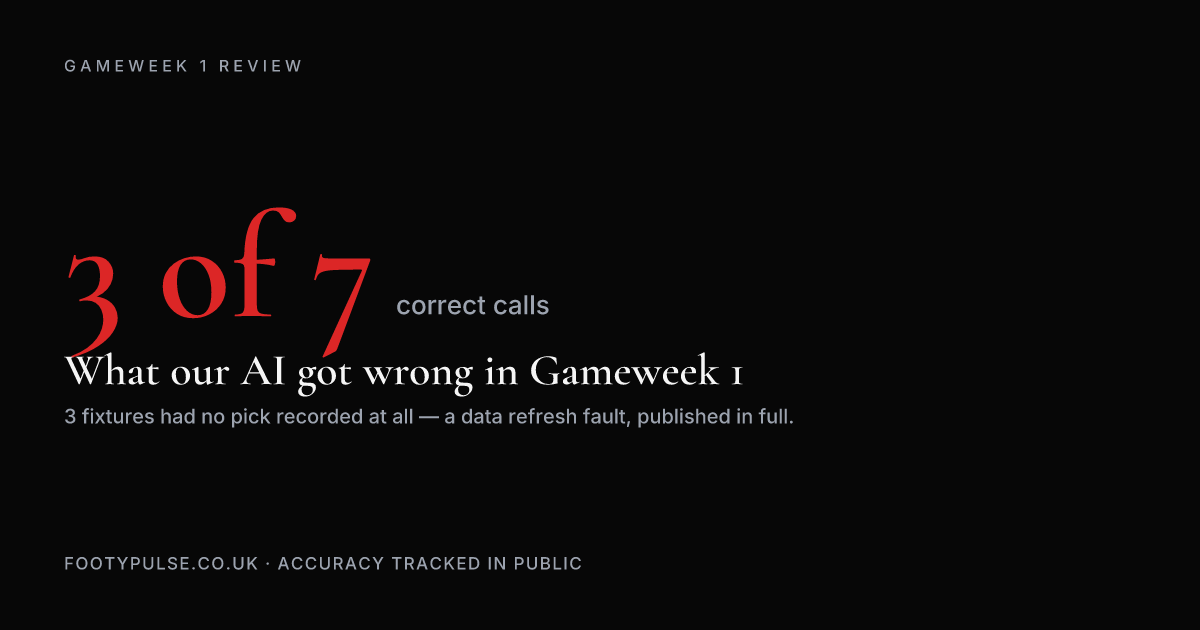
Opening weekends punish predictions. Squads are half-formed, new signings are bedding in, promoted sides arrive with nothing to lose, and a summer's worth of assumptions meets ninety minutes of reality. Gameweek 1 of the 2026/27 Premier League season did exactly that to our model — and rather than quietly move on, we're going to walk through it honestly, because a prediction record is only worth anything if you can see the misses as clearly as the hits.
Here is the plain version: on the seven Gameweek 1 fixtures we have a scored prediction for, FootyPulse's AI called three correct. That's 42.9%. It is not a good return, and we're not going to dress it up as one.
Here's the full picture — every call, on the record:
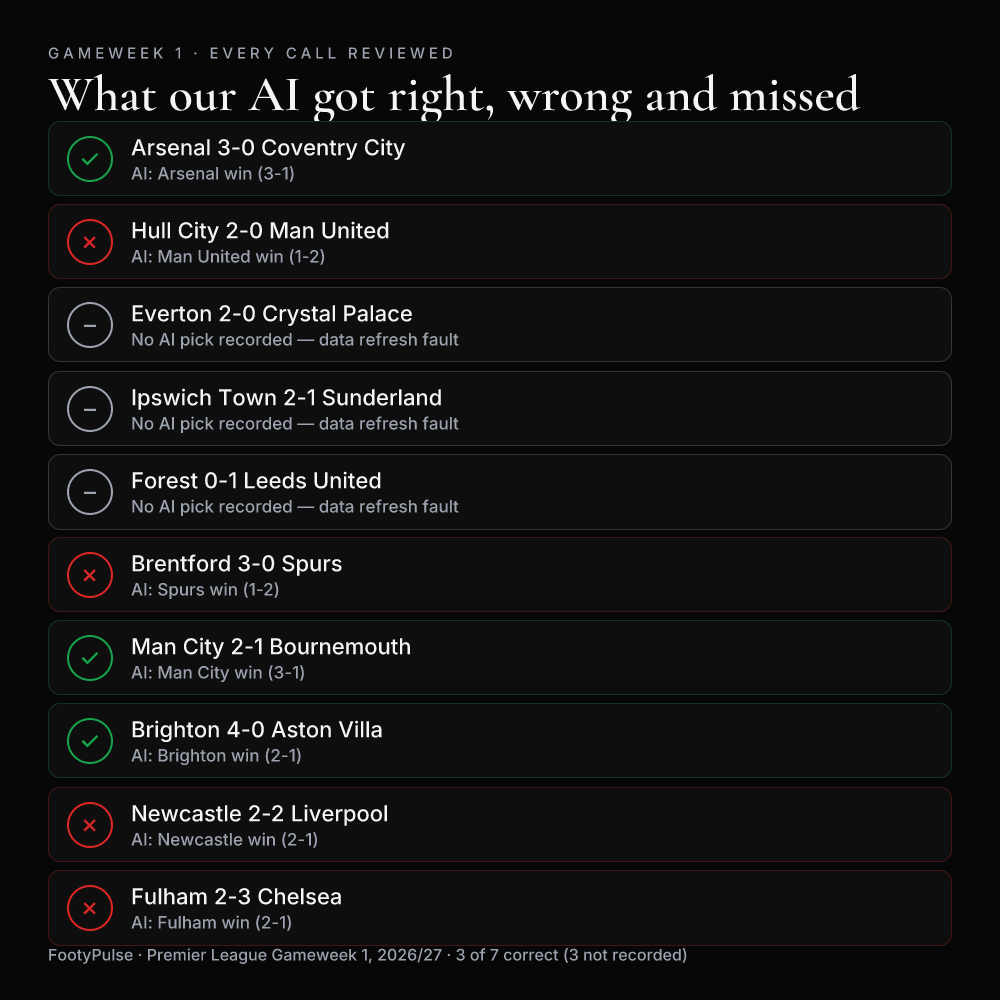
Three green ticks, four red crosses, three blanks. Let's take them in turn — starting, as we should, with what went wrong.
The three we got right
First, briefly, what worked, because it tells you where the model is strong. All three correct calls were confident home favourites who delivered: Arsenal beating Coventry 3-0, Brighton dispatching Aston Villa 4-0, and Manchester City seeing off Bournemouth 2-1. In each case the model leaned firmly towards the stronger, settled side at home, and in each case the game followed the script.
That's the comfortable zone for any prediction model: established quality at home against clearly weaker opposition. When the gap in level is wide and the venue reinforces it, the maths is straightforward and the AI gets it right. The trouble in Gameweek 1 came everywhere the picture was messier.
Hull City 2-0 Manchester United — the miss that stings most
If there's one result the model should sit with, it's this one. FootyPulse's AI backed Manchester United to win at the MKM Stadium. Newly-promoted Hull City won 2-0.
This is the classic opening-weekend trap. On paper — squad value, recent Premier League pedigree, the names on the teamsheet — Manchester United are the pick every time. But "on paper" is precisely the phrase that gets predictions in trouble in August. A promoted side at home on the opening day, roared on by a full house, carries a motivational and emotional charge that no pre-season data set captures well. The model weighted United's quality; it underweighted the chaos of an opening-day promotion party. Hull didn't just nick it — they won by two.
It's a defensible miss in the sense that most models and most pundits leaned the same way. But it's still a miss, and it's the sort the model needs to learn from: promoted sides at home, opening weekend, are worth more respect than the raw squad numbers suggest.
Brentford 3-0 Tottenham — beaten by the same lesson
The same trap, a different scoreline. The AI favoured Tottenham away at Brentford. Brentford won 3-0.
Two confident away calls for the bigger side, two home thrashings the model didn't see coming. Taken together, Hull and Brentford point at a genuine early-season blind spot: the AI was too quick to trust the away favourite and too slow to price in the intensity of a well-drilled home side on the front foot. Brentford have made a habit of exactly this kind of result under their current setup, and the model didn't lean into that pattern hard enough.
The two that slipped away late
Not every miss was a blowout. Two were the fine margins that decide predictions:
Newcastle 2-2 Liverpool — the AI backed a Newcastle home win. It ended level. A single moment either way and this is a correct call; instead it's a draw the model didn't have.
Fulham 2-3 Chelsea — the AI leaned towards Fulham at home. Chelsea edged it 2-3 in a game that swung on small margins. Again, the model was in the right neighbourhood — a tight game between well-matched sides — but landed on the wrong side of it.
These are less alarming than the promoted-side misses. Coin-flip fixtures resolve against you roughly half the time; that's the nature of tight games, not a flaw in the reasoning. But they count the same in the record, and the record is what we publish.
How that stacks up against the BBC
We track our AI against the BBC's three published predictions every gameweek — their own AI, Chris Sutton, and their weekly guest. Gameweek 1 didn't go our way there either:
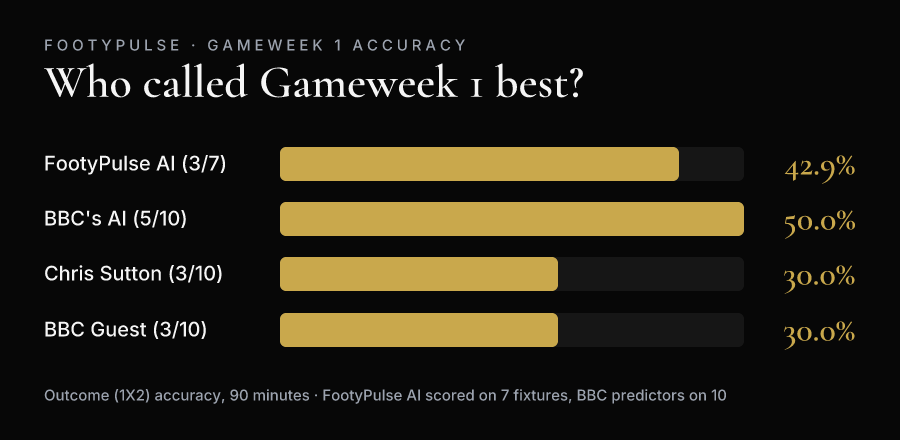
BBC's AI edged us this week at 50%, while we matched the human pundits and beat neither. We could leave that chart out of this article — no one would know. We're putting it in because the whole point of FootyPulse is that you can check our record against the alternatives, on the weeks we lose as well as the weeks we win. One gameweek is far too small to mean anything either way — but it's on the board, and so are we.
The three we can't score — and won't pretend we can
There's a part of Gameweek 1 we have to be straight about, because the alternative is worse. You'll have spotted three blanks in that grid at the top.
Three fixtures — Everton v Crystal Palace, Ipswich v Sunderland, and Nottingham Forest v Leeds — have no recorded FootyPulse prediction at all. A data-refresh fault deleted those predictions before kick-off. We caught it, but by then the accuracy freeze that stops predictions being edited had already applied.
Here's the important bit: we could have quietly generated predictions for those three fixtures after the results were known and slotted them into the record. Plenty of prediction sites would. We didn't, and we won't, because a prediction made after the final whistle isn't a prediction — it's a result with a costume on. So those three fixtures sit unscored. The record shows 3 from 7, not a tidied-up 3-from-10 with three convenient hindsight calls added.
That decision costs us. It would have been easy to pad the record. But the entire point of FootyPulse is that the accuracy figure means something, and it only means something if we hold ourselves to it on the weeks it hurts. This is one of those weeks.
Where this leaves us
One gameweek is a tiny sample, and we won't pretend a rough opening weekend proves anything about the model's quality over a season — any more than a good one would. Predictions are a long game, judged over dozens of fixtures, not ten. What Gameweek 1 does give us is a clear, honest starting point and a specific lesson: the model needs to respect promoted sides at home more than the raw numbers suggest, and August form is thinner ice than the data admits.
You can watch how that plays out. Every prediction we make is logged, scored and published — hits and misses — on our accuracy page, and you can see exactly how we stack up against the BBC's pundits, fixture by fixture, on our AI vs BBC's Predictions page. If the model keeps getting promoted sides wrong, you'll see it there before we say a word about it.
That's the deal. We show the working, we show the misses, and we don't backdate the awkward ones. Gameweek 1 wasn't our finest — and now it's on the record for good.
FootyPulse publishes an AI match prediction for every Premier League fixture, tracks its accuracy in public, and re-predicts live at half-time. We're not a tipster and we don't sell betting tips — just transparent, data-driven football analysis you can hold us to.
Share this article: