Half-Time Re-Predictions Explained
Published 6 August 2026 · FootyPulse AI Analysis
5 min read · Updated 14 August 2026
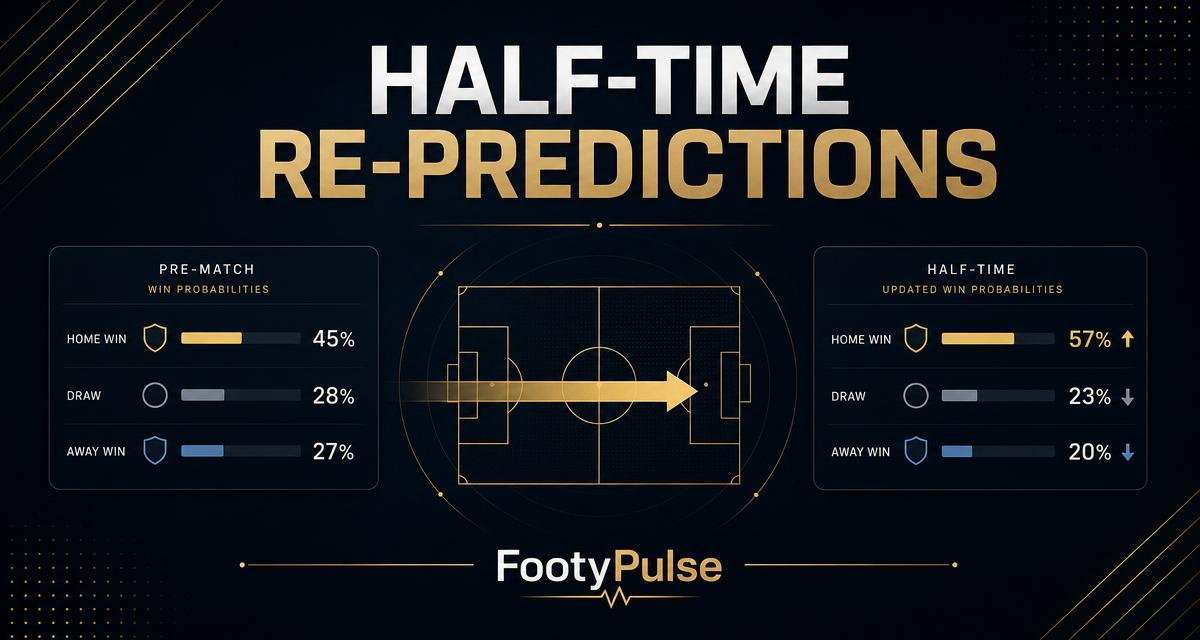
The final whistle isn't the only moment that matters. At half-time, FootyPulse's AI rebuilds the picture using what's actually happened on the pitch — not what we expected before kick-off.
Every pre-match prediction is a best guess based on form, history and squad strength. It's a solid starting point — but it's still a guess made before a ball's been kicked. Forty-five minutes later, you've got something far more valuable: real data from the match itself.
That's the gap our half-time re-predictions are built to close.
What Are Half-Time Re-Predictions?
A half-time re-prediction is a fresh forecast generated at the interval, built entirely from what's happened in the first 45 minutes rather than pre-match assumptions. Instead of sticking with a prediction made hours or days earlier, the model re-reads the game using live first-half data and produces an updated view of how the second half is likely to unfold.
It's not a tweak to the original prediction. It's a new calculation, grounded in what's actually gone on out there.
The Three Signals That Rebuild the Picture
Three data points drive the half-time recalculation:
Possession — not just the raw percentage, but where and how it's been used. A side dominating the ball in deep, non-threatening areas tells a different story to one controlling play in the final third.
Shots — the volume and quality of chances created and conceded. A scoreline can flatter or flatter to deceive; shot data doesn't lie about which side has actually threatened.
Momentum — how the game has trended across the half rather than a single snapshot. A team that started slowly but has grown into the half carries different second-half expectation to one that's fading after a fast start.
Individually, none of these tells the whole story. Together, they let the model build a genuinely updated read on the match — one that reflects the 45 minutes just played, not the assumptions that existed before it.
Why a Half-Time Re-Prediction Beats Sticking With the Pre-Match Odds
Pre-match predictions are built on the best information available at the time: form, head-to-head history, table position, injuries. All useful — and all fixed the moment the whistle goes.
Football doesn't always play out to form. A false favourite can be second-best for 45 minutes. An underdog can control large spells without it showing on the scoreboard. A pre-match prediction has no way of knowing any of that — it was calculated before the game gave up any information about itself.
The half-time re-prediction solves that by throwing out nothing but assumption and rebuilding the view from real match data. It's the difference between predicting a game and reading one.
A Worked Example
To illustrate how this works in practice — this is a hypothetical scenario, not a real match — imagine a pre-match forecast gives the home side a moderate edge based on their form and table position. At half-time, though, the away side has had the better spells of possession in dangerous areas, created the higher-quality chances, and finished the half the stronger of the two teams. The half-time re-prediction picks all of that up and shifts its second-half view accordingly — not because the scoreline demands it, but because the underlying data does.
That's the point of the feature: it responds to how the match is actually being played, not just what the table said beforehand.
Built on the Same Principle as Everything Else on FootyPulse
We don't just publish predictions — we publish our full record, win or lose, on the AI vs Pundits leaderboard and our accuracy page. Half-time re-predictions run on the same principle: an honest, data-led read rather than a hyped-up "lock of the week." No guaranteed outcomes, no tipster language — just an updated view built on what the first half actually showed.
If the pre-match prediction and the half-time re-prediction land in the same place, that's useful confirmation. If they diverge, that's exactly the moment worth paying attention to.
How to Get It
Half-time re-predictions are a Pro feature, live on every covered fixture once the interval hits. Free users get our full pre-match prediction and win probability as standard — Pro unlocks the half-time re-prediction alongside exact scoreline predictions.
Take Advantage by Upgrading to Pro Membership.
FAQ
What are FootyPulse's half-time re-predictions? An updated match prediction generated at half-time, built from first-half possession, shots and momentum data rather than pre-match form and history.
What data does the half-time re-prediction use? Three first-half signals: possession (including where it's been used), shot volume and quality at both ends, and momentum trends across the half.
Are half-time re-predictions available on the free tier? No — it's a Pro feature. Free users get FootyPulse's full pre-match prediction and win probability; Pro adds the half-time re-prediction and exact scoreline predictions.
Which matches get a half-time re-prediction? Every fixture FootyPulse covers with a pre-match prediction is eligible, across the Premier League and our other tracked competitions. If a match has a pre-match prediction on the site, it gets a half-time re-prediction once live first-half data is available.
When does the half-time re-prediction appear? At the interval — it is generated as soon as the first half ends and is normally on the match page within a couple of minutes of the half-time whistle, well before the second half kicks off.
What exactly do Pro members receive? An updated win/draw/win probability split, a refreshed exact scoreline prediction, and a short written read on what changed in the first half and why the numbers moved — shown alongside the original pre-match prediction so you can see the shift.
How accurate is the half-time re-prediction compared to the pre-match prediction? We don't cherry-pick numbers to answer that — our full prediction record, including how pre-match and half-time re-predictions have performed, is published openly on our accuracy page rather than claimed here.
Share this article: